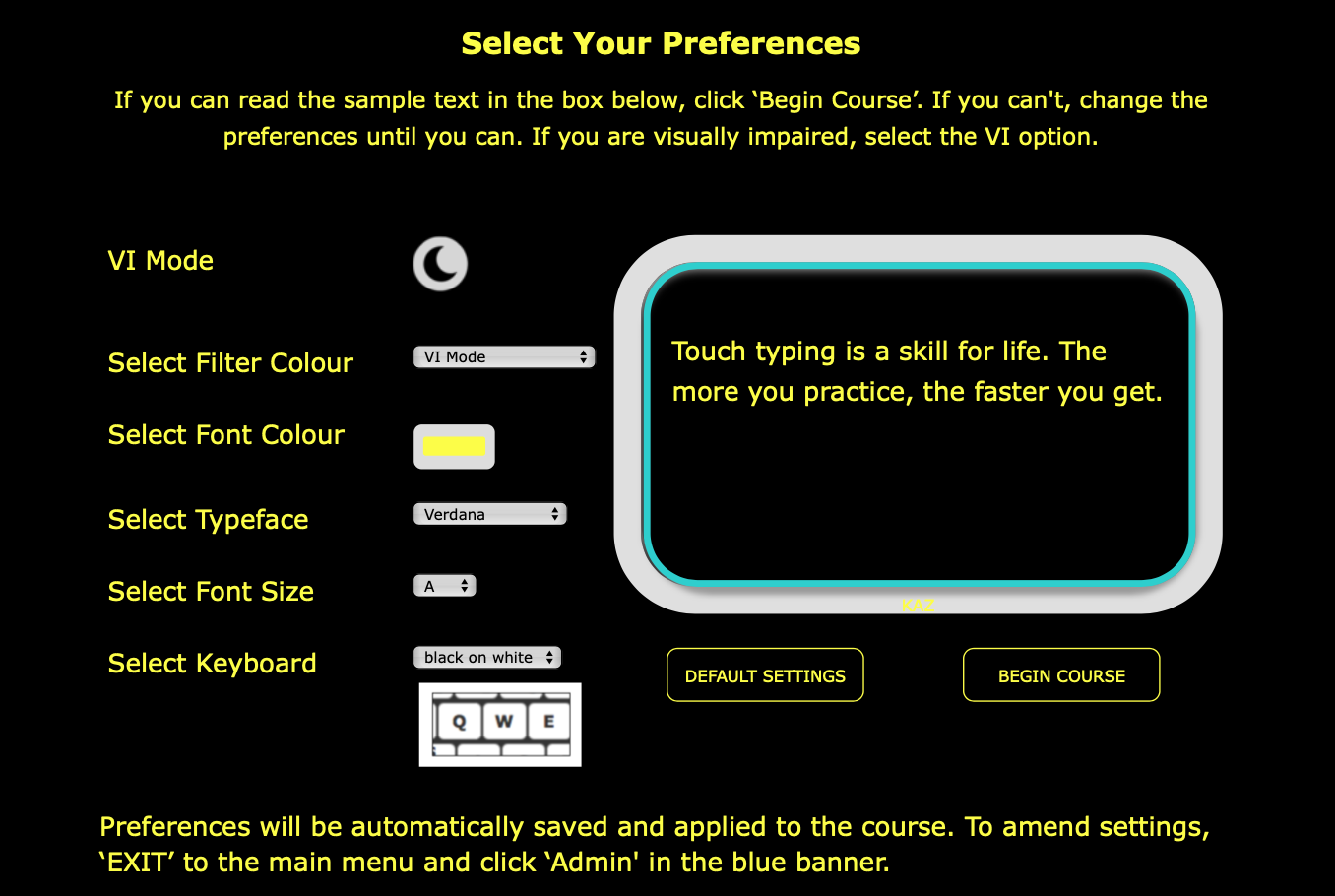
Touch Typing Software for the Visually Impaired & Blind
Specialised edition developed with advice and guidance from the
Thomas Pocklington Trust
Compatible with:
JAWS and other screen readers
Dolphin SuperNova and other magnification software/hardware
Google and other captioning software
Learning to touch type is considered one of the most beneficial skills for visually impaired and blind individuals. This is because it allows them to transfer their thoughts easily and automatically onto a screen. It provides them with an invaluable tool and asset for independent working and communicating.
Learning to touch type at any age can dramatically boost confidence, self-belief and independence. However, teaching learners with visual impairment at an early age can drastically transform their experience whilst at school and in FE/HE. It puts them on a more even standing with their sighted peers and opens doors to new career opportunities.
Achieving muscle memory and automaticity when touch typing increases efficiency and productivity. However, most importantly, it frees the conscious mind to concentrate on planning, composing, processing and editing, greatly improving the quality of the work produced.
The KAZ Course
The KAZ course is a tutorial and is designed to be used independently or with minimum supervision. However, a structured lesson plan is available in Administrators’ admin-panels should they wish to teach the course during lessons.
The course consists of five modules:
Module 1– Flying Start - explains how the course works, teaches the home-row keys, correct posture whilst sitting at the keyboard, and explains the meaning, causes, signs, symptoms and preventative measures for Repetitive Strain Injury.
Module 2– The Basics - teaches the A-Z keys using KAZ’s five scientifically structured and trademarked phrases.
Module 3– Just Do It - offers additional exercises and challenge modules to help develop ‘muscle memory’, automaticity and help ingrain spelling.
Module 4– And The Rest - teaches punctuation and the number keys.
Module 5– SpeedBuilder - offers daily practice to increase speed and accuracy.
1. Understand the Hardware & Limitations
- CPU: RTL8196E (MIPS 24Kc, ~400 MHz, no FPU).
- Switch: Built-in RTL8196E includes a 5-port Fast Ethernet switch (VLAN-aware).
- WiFi: Often paired with RTL8192CE/RE (PCIe/USB) – requires proprietary Realtek driver (
rtl8192ce).
- Flash/RAM: 4–16 MB flash, 32–64 MB RAM (very tight).
- OpenWrt support: Not officially supported in mainline. You must use vendor SDK (Realtek
RtkLinux based on kernel 2.6.30/3.10) or community attempts.
: None. OpenWrt does not officially support the Lexra architecture used in the RTL8196E. Technical Roadblocks
The major bottleneck is RAM. OpenWrt’s standard build requires ~64MB to run comfortably with a web interface (LuCI). Running it on 16MB is like trying to run Windows 11 on a Pentium II.
: Some unofficial "Barrier Breaker" (14.07) builds were developed but are now severely outdated and may contain security vulnerabilities. Custom Repositories : Developers like have hosted custom repositories for
Part 1: What is the RTL8196E?
The RTL8196E is a MIPS-based network processor (usually 24Kc or similar core) clocked between 350MHz and 400MHz. It integrates:
- make menuconfig — choose Target System = MIPS, Target Profile = (closest device), select minimal packages to fit flash.
That said, the Linux 6.1 and 6.6 kernels have a driver called realtek_rtl8196c, which allows basic ethernet routing without Wi-Fi. If you are comfortable compiling your own kernel, you can build OpenWrt from source:
Key constraints:
Rtl8196e Openwrt May 2026
1. Understand the Hardware & Limitations
- CPU: RTL8196E (MIPS 24Kc, ~400 MHz, no FPU).
- Switch: Built-in RTL8196E includes a 5-port Fast Ethernet switch (VLAN-aware).
- WiFi: Often paired with RTL8192CE/RE (PCIe/USB) – requires proprietary Realtek driver (
rtl8192ce).
- Flash/RAM: 4–16 MB flash, 32–64 MB RAM (very tight).
- OpenWrt support: Not officially supported in mainline. You must use vendor SDK (Realtek
RtkLinux based on kernel 2.6.30/3.10) or community attempts.
: None. OpenWrt does not officially support the Lexra architecture used in the RTL8196E. Technical Roadblocks
The major bottleneck is RAM. OpenWrt’s standard build requires ~64MB to run comfortably with a web interface (LuCI). Running it on 16MB is like trying to run Windows 11 on a Pentium II. rtl8196e openwrt
: Some unofficial "Barrier Breaker" (14.07) builds were developed but are now severely outdated and may contain security vulnerabilities. Custom Repositories : Developers like have hosted custom repositories for CPU: RTL8196E (MIPS 24Kc, ~400 MHz, no FPU)
Part 1: What is the RTL8196E?
The RTL8196E is a MIPS-based network processor (usually 24Kc or similar core) clocked between 350MHz and 400MHz. It integrates: : None
- make menuconfig — choose Target System = MIPS, Target Profile = (closest device), select minimal packages to fit flash.
That said, the Linux 6.1 and 6.6 kernels have a driver called realtek_rtl8196c, which allows basic ethernet routing without Wi-Fi. If you are comfortable compiling your own kernel, you can build OpenWrt from source:
Key constraints:
Copyright KAZ Type Limited 2025. KAZ is a registered trade mark of KAZ Type Limited.
Developed by : STERNIC Pvt. Ltd.